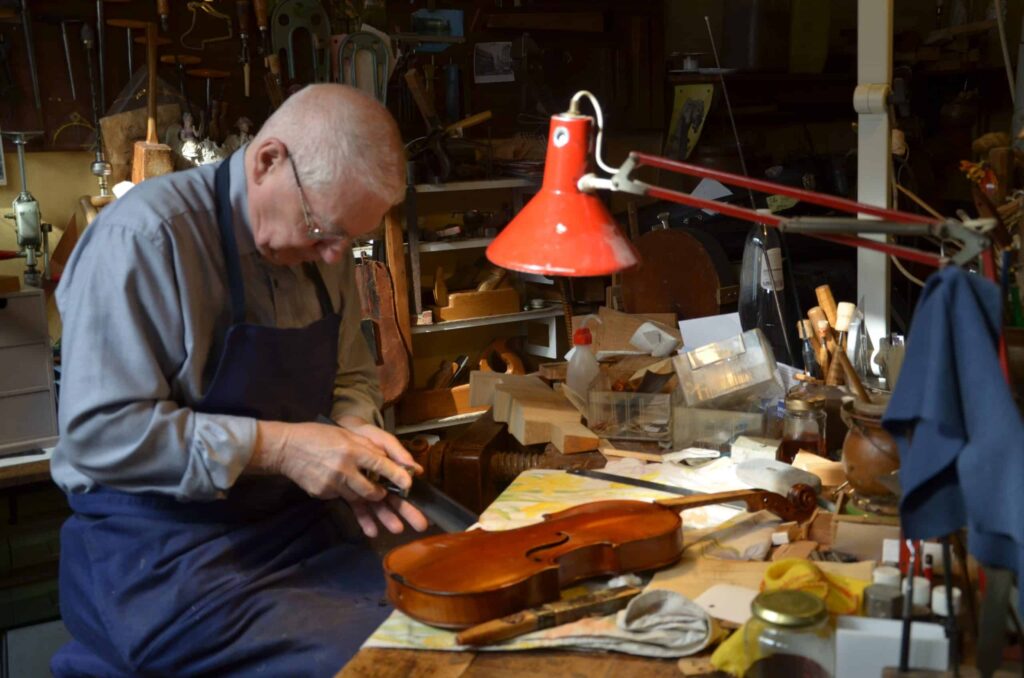
Although short and narrow, Rue des Foxes is home to people and places that fascinate me. No. 1, a white house with pearl gray woodwork. On the ground floor, a workshop.
Through the window, I see numerous tools, various violins, a workbench in front of which Antoni Jassogne, a luthier craftsman, is working. I ring the bell. He gets up and smiling, lets me enter his den where I am enveloped by a smell of varnish and tree resin.
To my question: “What is a violin maker?”, his barely perceptible but precise voice aligns me with the tranquility that reigns in his workspace: “A luthier is the artisan who builds and restores string instruments such as violin, viola, cello, double bass.”
Musician and Craftsman
In addition to the music he studied at the Royal Conservatory of Music in Mons, where he was awarded first prize, before starting bass lessons, Antoni Jassogne has another passion, woodworking. One day, originally from Bruges, who spent a large part of his life in Charleroi, he traveled to southern Poland, the land of his maternal ancestors. In Zakopane, he learned the construction technique from master luthier Franciszek Mardula. He continues his apprenticeship with Jean-Frédéric Schmitt, a famous luthier from Lyon and a great master of string instrument restoration. Back in Belgium, he set up his workshop on Place du Sablon before establishing it in 1992 at No. 21 Rue des Renards.
Crafting an Instrument
“The starting point of an instrument comes from the reflection of the luthier,” he explains. It is from the rule of the golden ratio that he designs each of his creations. This principle can be found in the dimensions of the Pyramid of Khufu built in Egypt over 4,500 years ago, in the Doric columns of the Parthenon erected in Greece between -447 and -438, in the Gothic cathedrals of major European cities in the Middle Ages, and in many works of the Renaissance (it was then called “divine proportion”).
Applying this irrational number, represented by the Greek letter phi, from the tip of the pencil, on drawing paper, he draws straight lines and curves that follow and intersect to start the plan of a clean design which he fixes with a compass and square to create a proportion that he considers particularly aesthetic. From this sketch, the rounded shapes of the scroll located at the end of the neck, the soundboard, the part of the instrument that amplifies sounds, and the f-holes, the symmetrical openings that allow the vibrations of the soundboard.
Manufacturing
With his perfect pitch, he listens to the instruments without a tuning fork; with his hands, the soundboard, the neck, the pegs, the button, the tailpiece, the bridge, the fingerboard emerge from blocks of spruce, rosewood, maple, ebony, which he carefully selects for their origin and age. Methodically and skillfully, he gathers the various elements (around 80) by attaching them with hot glue before covering the instrument with 5 or 6 layers of varnish, which he prepares with natural resins and essential oils. From a piece of spruce, he will have to shape the “soul,” a small piece of wood that will amplify the sound. He will position it inside the instrument using the “soul point,” in the presence of the buyer if it is a restoration.
As a restorer, he follows the path of his creations like others; for 10 years, he has cared for a Guarnerius Del Gesu from 1744, belonging to Arthur Grumiaux, a Belgian violinist of international renown (1921-1986).
I leave Antoni Jassogne happy to have met a sensitive being, particularly gifted who, despite his knowledge and skills recognized by his peers, rejects the title of “Master” which he finds burdensome and chooses the title of “Craftsman.”
•Nicole
Tag: take a lutherie training