
You’re sending a parcel to Canada, Japan or Réunion, and the post office asks you for a CN22 form. This small green document, attached to the package, serves as a simplified customs declaration. It tells the authorities in the destination country what your parcel contains, how much it weighs and what it’s worth. Without it, your parcel could be held up, taxed or returned.
Paper CN22 or electronic declaration: what’s changed depending on the destination
The printed CN22 form is still valid for low-value postal shipments sent through La Poste. Fill it in by hand or on a computer, attach it to the parcel, and send it with your shipment.
However, the paper version is no longer enough everywhere. Several countries now require customs data to be submitted electronically before the parcel arrives.
In practice, if you drop off a parcel at a La Poste counter addressed to one of these countries, the CN22 data is entered digitally in addition to the paper form. The postal operator handles this transmission. If you prepare your shipment online through the La Poste website, however, the electronic declaration is generated automatically.
For a shipment to a French overseas department (Guadeloupe, Martinique, Réunion, French Guiana, Mayotte), the paper CN22 remains standard. Customs formalities apply because these territories have a separate tax regime, but advance electronic transmission is not required under the same procedure.
So check the destination before preparing your form. A shipment to Switzerland is subject to different requirements from one to the United Kingdom. Knowing the difference helps avoid unpleasant surprises during customs clearance. You can download the CN22 form to print if you’d like to fill it in at home before going to the post office.
Filling in the CN22 form: what to enter in each box
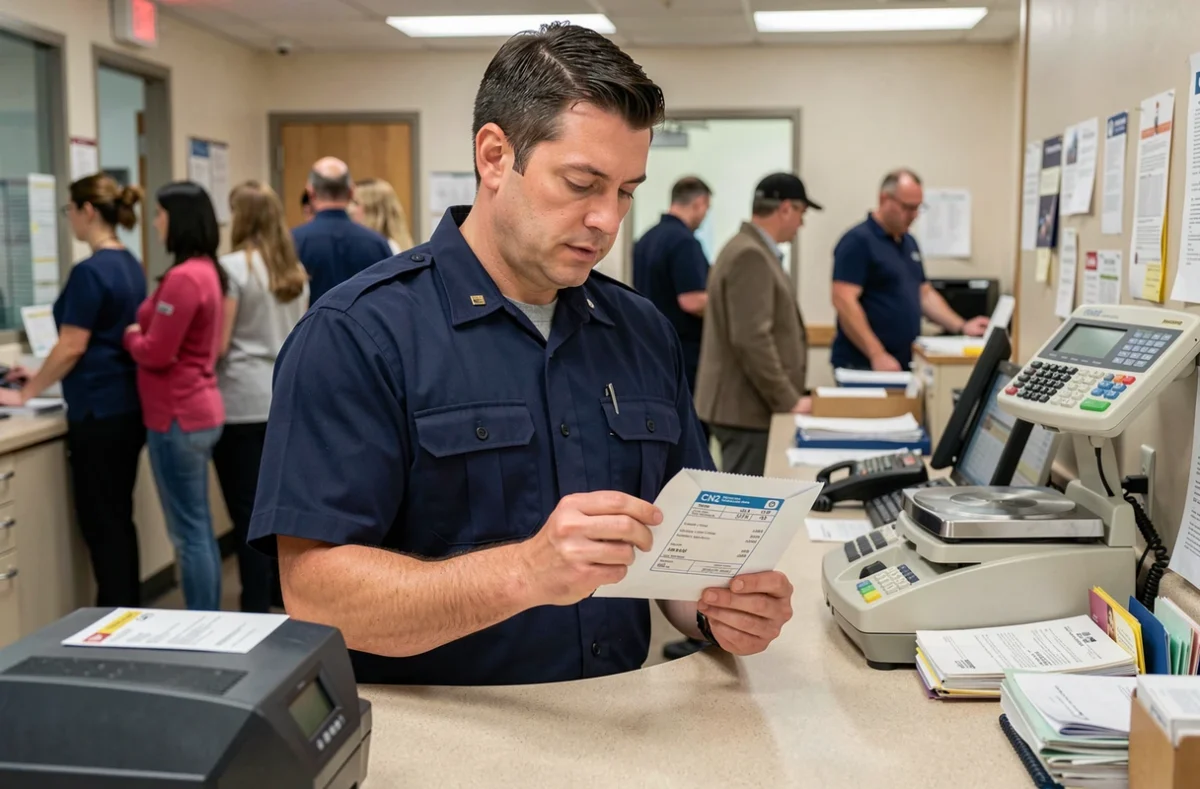
The CN22 is about the size of a postcard. It has only a few boxes, but each one matters. A mistake or omission can delay your parcel by several days.
Type of shipment
The first section asks you to tick a category: gift, documents, commercial sample, merchandise or “other”. Tick the box that accurately describes the contents. A birthday present is a gift. A product sold on a marketplace is merchandise. Marking a commercial shipment as a “gift” can result in customs penalties.
Description of contents
Describe each item precisely. “Clothing” isn’t enough: write “2 men’s cotton T-shirts”. Customs authorities reject vague descriptions such as “miscellaneous items” or “personal effects”.
- State the quantity of each item (for example, “3 books”, “1 pair of shoes”).
- Specify the material where relevant (leather, cotton, ceramic, plastic).
- Add the customs tariff code (6-digit HS code) if you know it, as this can speed up customs clearance.
Weight and value
Enter the net weight of each item in kilograms. Don’t confuse this with the total weight of the packed parcel. Declare the value in your country’s currency, which means euros.
Undervaluing goods to reduce the recipient’s customs duties is fraud. Enter the actual purchase price or, for a gift, an honest estimate of its market value.
CN22 or CN23: how to choose the right customs form
The CN22 and CN23 are used for different types of shipments. Using the wrong form can hold up your shipment.
- The CN22 is used for low-value postal shipments that are also relatively light (letters or small parcels).
- The CN23 is used for higher-value parcels or shipments requiring a more detailed description. It is longer and asks for additional information (export licence number, certificate of origin).
- For shipments worth more than 1,000 euros, neither the CN22 nor the CN23 is sufficient. La Poste then prepares a formal customs declaration (Single Administrative Document) on the sender’s behalf.
In practice, most shipments sent by individuals (gifts, small online purchases, documents) use the CN22. The CN23 is more commonly used by online retailers shipping goods of moderate value.
Print and attach the CN22 to your parcel
Once you’ve filled in the form, the next step is simple, but it needs to be done carefully.
Printing
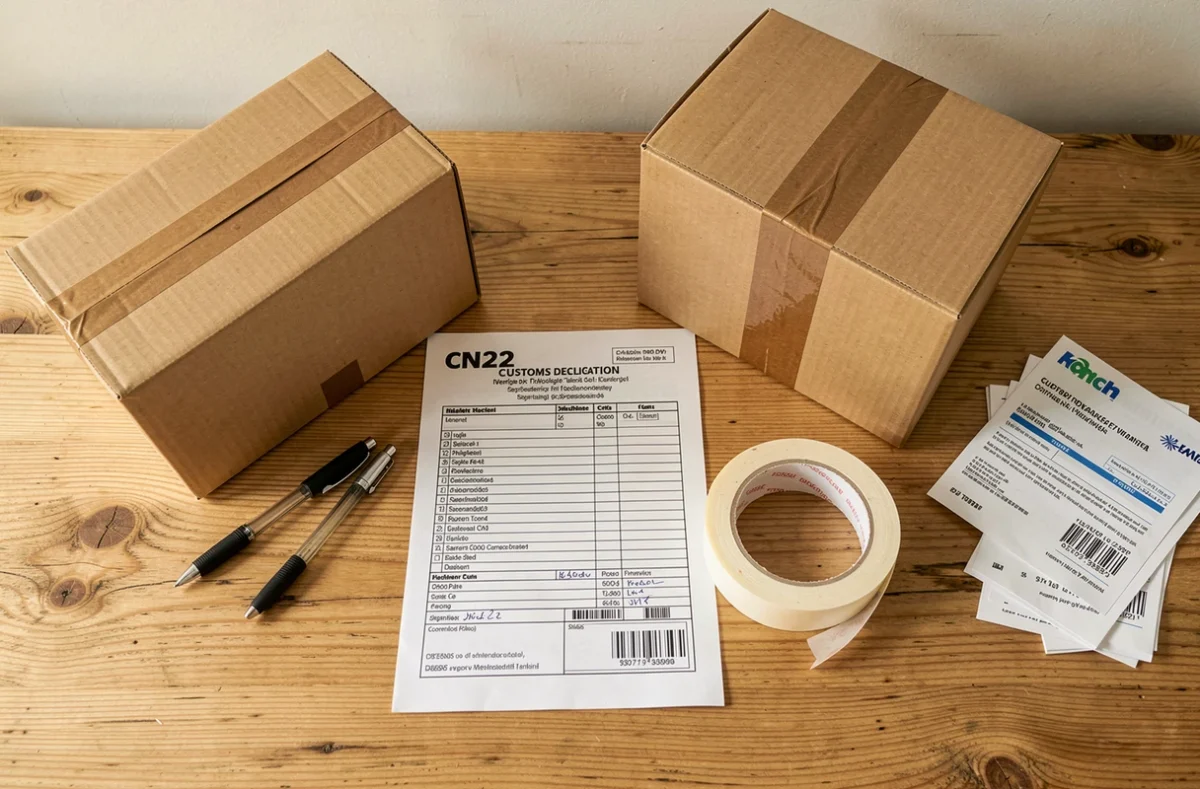
Print the CN22 on standard paper. The text must be easy to read and printed in a sufficiently large font. If you filled it in by hand, use a black-ink pen and write in capital letters. Customs officers process thousands of forms every day: an illegible document ends up in the pile of parcels awaiting processing.
Attaching it to the parcel
Attach the CN22 to the outside of the parcel in a clear, self-adhesive plastic pouch. Don’t put it inside the packaging. Customs officers must be able to read it without opening the parcel.
If you’re including a commercial invoice or proof of value, put it in the same pouch, behind the CN22. All supporting documents must remain visible on the outside of the parcel.
Check before sending
Review every box. Make sure the description matches the actual contents. If a customs inspection finds a discrepancy between the declaration and the contents, it will cause at least a delay and, at worst, a fine or seizure.
The CN22 is a short form, but the accuracy of the information you provide determines how smoothly your shipment will go. A correctly declared parcel can clear customs in just a few hours. A poorly declared parcel may be held up for several weeks, especially when sent to destinations with stricter checks. Take three minutes to fill it in correctly: it’s the best use of your time when sending an international parcel.