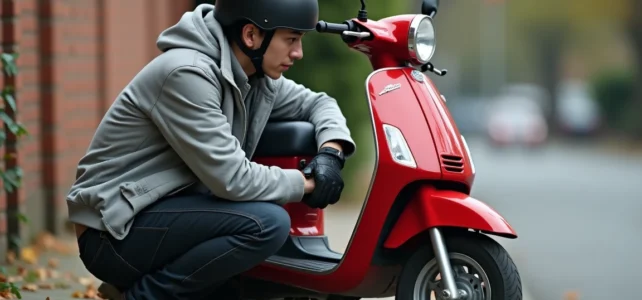
A well-maintained 50cc two-stroke thermal engine can endure several tens of thousands of kilometers before showing signs of critical wear. On a four-stroke (like the Honda Dax or Yamaha YBR), this endurance increases even further. The real issue is not the raw mileage displayed on the odometer, but the actual cost per kilometer once overall wear is factored in.
Cost per kilometer of a 50cc: the true end-of-life indicator

We regularly observe thermal 50cc scooters displaying modest mileage, yet their operating costs have already surpassed any economic logic. The end of life for a 50cc is not just about a blown segment or a scratched piston. It is measured at the point when the cumulative annual cost (routine maintenance, wear parts, insurance, technical inspection) relative to the kilometers traveled exceeds the profitability threshold compared to a replacement.
For an urban thermal 50cc, the key areas to monitor are engine oil changes, tire replacements, brake pads, the transmission (chain or belt depending on the model), and, for two-strokes, the cost of mixing oil. The insurance for a 50cc motorcycle remains relatively stable from year to year, but recurring breakdowns after a certain wear threshold can significantly inflate the bill.
The motorcycle technical inspection, now mandatory even for thermal 50ccs, adds a fixed cost of about 50 euros every three years. This amount seems low in isolation, but for a vehicle whose residual value drops quickly, it weighs heavily in the overall calculation.
We recommend keeping a detailed maintenance log from the moment of purchase. A simple table (date, type of intervention, cost, mileage) allows you to identify the tipping point, where the maximum mileage for a 50cc motorcycle according to Antoine le Pilote meets your own profitability threshold.
Engine wear and critical components on a thermal 50cc
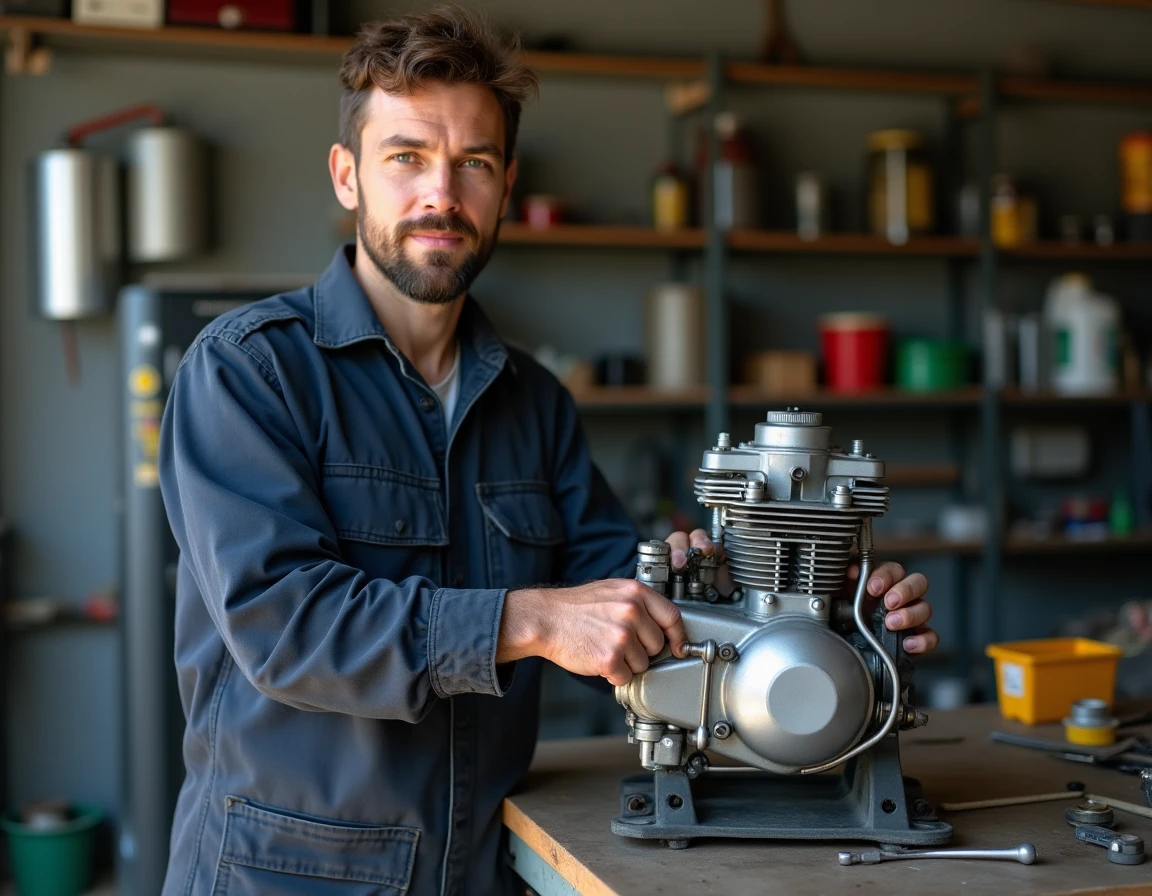
On a two-stroke, the cylinder, piston, and crankshaft form the main wear trio. A cylinder-piston kit should be replaced preventively according to the manufacturer’s recommendations, and its cost remains accessible on most common models (Derbi, AM6, Minarelli). Neglecting this replacement risks an irreversible engine seizure.
On a 50cc four-stroke, wear is more gradual. The chain-driven distribution requires regular valve clearance adjustments. A well-maintained four-stroke engine lasts significantly longer than a two-stroke used in the city with repeated acceleration/braking phases.
Inverted fork and rolling chassis
Field reports show that the lifespan of a 50cc inverted fork directly depends on the frequency of fork oil changes. An interval that is too long leads to degradation of the seals, followed by a loss of damping that accelerates tire and steering bearing wear. This aspect is often overlooked on sporty 50ccs with gearboxes, even though it conditions road holding and safety.
- Fork oil change according to the manufacturer’s recommended intervals, more frequently in intensive urban use
- Replacement of seals as soon as seepage appears on the tubes
- Checking the steering column bearings at each front tire change
- Checking the tension and condition of the chain (or belt) every few hundred kilometers
Range and battery lifespan of a 50cc electric scooter
An electric scooter equivalent to a 50cc does not raise the same mechanical wear questions. The brushless motor has virtually no wear parts. However, the lithium-ion battery is the most expensive and sensitive component of the vehicle.
The range per charge varies depending on the battery capacity and usage profile. On a model equipped with a battery of a few kWh, the manufacturer generally announces several tens of kilometers in urban cycles. In practice, external temperature, the weight of the rider, and elevation significantly reduce this range.
Preserving the battery in the long term
Specialized maintenance guides published since 2024 converge on three concrete rules to maximize battery lifespan:
- Never let the charge drop below 20% before recharging the scooter
- Avoid systematic overnight charging that keeps the battery at 100% for hours
- Limit the charging duration to four or five hours to reduce thermal stress on the cells
Following these guidelines helps maintain the usable capacity of the battery much longer. Conversely, negligent use (repeated deep discharges, prolonged storage at full charge) accelerates degradation and reduces range in just a few seasons.
50cc thermal or electric: what total mileage to expect
A well-maintained two-stroke thermal 50cc generally covers several tens of thousands of kilometers before a major engine overhaul. A four-stroke can exceed this, provided that oil change and distribution adjustment intervals are respected. The symbolic threshold depends less on the engine than on the overall chassis, suspension, and braking.
On a 50cc electric scooter, the concept of total mileage translates mainly into the number of charge cycles. A lithium-ion battery gradually loses its capacity, and it is this degradation that determines the economic lifespan of the vehicle, well before any mechanical failure.
In both cases, the actual lifespan is managed through preventive maintenance and tracking the cost per kilometer. A thermal 50cc whose annual maintenance cost exceeds the resale value of the vehicle has reached its economic end of life, regardless of the apparent condition of the engine. For an electric scooter, it is the replacement cost of the battery relative to the remaining mileage that determines the issue.