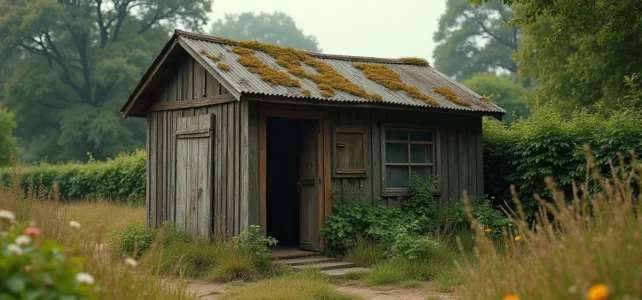
Setting up a shed on a plot of land classified as non-buildable may seem simple, but urban planning law treats this act like any other construction. The zoning of the local urban plan (PLU) takes precedence over everything else, including what the land registry indicates. Before pouring a slab or even screwing together a kit shed, it is essential to understand what the municipality actually allows on the targeted parcel.
Land Registry and PLU Zoning: Two Documents That Say Different Things
The land registry records the existence of a building. It identifies the parcels, their boundaries, and the existing constructions. A shed may be listed there without granting any right to build or inhabit.
The document that determines what can be done on a piece of land is the PLU (or the municipal map in smaller municipalities). It classifies each parcel as urban (U), to be urbanized (AU), agricultural (A), or natural (N). A non-buildable plot generally falls under an A or N zone, where new constructions are usually prohibited.
Confusing these two documents is the most common mistake. To properly understand the regulations for sheds on non-buildable land, one must always start from the zoning, never from the land registry.
Urban Planning Authorizations for a Shed: Surface Thresholds and Procedures at the Town Hall
Even on a buildable plot, placing a shelter or shed requires compliance with administrative thresholds. On a non-buildable plot, these thresholds also apply, but they often clash with a principle prohibition related to zoning.
Are you wondering if a small shelter of a few square meters goes under the radar? The Urban Planning Code provides for three levels:
- Below a certain footprint (generally for very small structures), no formalities are required in urban areas covered by a PLU. In non-buildable zones, this exemption does not equate to a building permit.
- Beyond this first threshold, a prior declaration of works must be submitted to the town hall. This applies to most garden sheds and modest-sized cabins.
- For larger structures, a building permit is mandatory. The town hall’s urban planning department then reviews the application in light of the PLU.
On a non-buildable plot, the town hall will refuse the prior declaration or permit if the PLU prohibits any construction in A or N zones. The fact that the structure is removable, made of wood, or small in size does not change the principle.
STECAL and Exceptions: When Non-Buildable Zones Open a Door
The Urban Planning Code provides for a little-known mechanism to the general public: STECAL (sectors of limited size and capacity), defined in article L.151-13. These sectors allow, within agricultural and natural zones, certain constructions or installations under strict conditions.
Several recent PLUs use this tool to regulate non-standard habitats (yurts, tiny houses, removable residences) in N and A zones. The conditions generally concern limited density, the reversibility of the installation, and the absence of connection to heavy networks.
For a shed, a STECAL may represent the only legal means of installation on a non-buildable plot. However, not all PLUs include them, and those that do target specific uses. Checking for the existence of a STECAL on the parcel is the first step before any project.
Existing Shed for a Long Time: The Question of Precedence
A shed that has been on a parcel for several decades presents a particular case. If it was built before the current PLU came into effect, it may benefit from an acquired right allowing its maintenance and upkeep.
This right does not automatically cover expansion, elevation, or change of use (transforming a storage shed into a dwelling, for example). Each modification must be examined in light of the applicable zoning regulations.
Concrete Risks of Building Without Authorization on Non-Buildable Land
Building a shed without complying with the PLU constitutes an urban planning offense. The town hall or the departmental directorate of territories can draw up a report, even years after the construction.
The consequences are not limited to a fine. The court may order the demolition of the construction and the restoration of the land, at the owner’s expense. Several practitioners report an increase in compliance checks, especially when the declared construction does not match what was actually built (different surface area, height, location).
Another common pitfall: selling a plot with an irregular shed. The buyer inherits the litigation risk. The notary may report the situation, but the responsibility for regularization falls on the owner.
Development Tax and Shed Taxation
As soon as a shed is subject to an urban planning authorization (prior declaration or permit), it falls within the scope of the development tax. This tax, calculated on the enclosed and covered area, is due in one or two installments after the authorization is granted.
An undeclared shed escapes this tax but exposes its owner to the sanctions described above. Subsequent regularization, when possible, triggers the payment of the tax retroactively.
Dematerialization of Urban Planning Requests: What Changes for Shed Projects
Decree No. 2024-1043 of November 18, 2024, makes the electronic submission of urban planning authorization requests mandatory for construction professionals. If you hire a builder or architect for your shed project, the request now goes through a digital portal.
For individuals, paper submission at the town hall remains possible. Dematerialization does not change the substantive rules, but it accelerates the processing and traceability of files. Every shed project now leaves a digital footprint that is harder to ignore.
Before purchasing a kit shelter or planning the construction of a shed, consult your municipality’s PLU at the town hall or on the urban planning geoportal. Check the exact zoning of the parcel, the possible existence of a STECAL, and the specific rules for the sector. This free step avoids months of litigation and the potential loss of a construction that you may be asked to demolish.